The star that changed the universe
One night, one photographic plate and one exclamation mark.
How this site works. Every fact is in our own words and linked to its source, beside it. Where good sources disagree, we show each version in a “Sources differ” box.
Before Hubble
It was mentioned as early as 965 CE in the Book of the Fixed Stars by the Islamic astronomer al-Ṣūfī. Britannica
It was rediscovered in 1612, soon after the telescope was invented, by the German astronomer Simon Marius. Britannica Marius said it looked like the light of a candle seen through a horn. Britannica
For centuries astronomers thought it was part of the Milky Way, a ‘spiral nebula’, hence the old name Andromeda Nebula. Britannica
As far back as 1912, astronomers realised Andromeda, then thought to be only a nebula, was heading our way. NASA, 2025
Step through it: October 1923
Pick a step to see what happened.
All five steps are shown below.
Step 1: An island universe?
In the early 1900s most astronomers thought the Milky Way was a single ‘island universe’ with nothing observable beyond it. NASA, V1
Andromeda was catalogued as just one of many faint, fuzzy ‘spiral nebulae’. NASA, V1
Step 2: The night of 5 October 1923
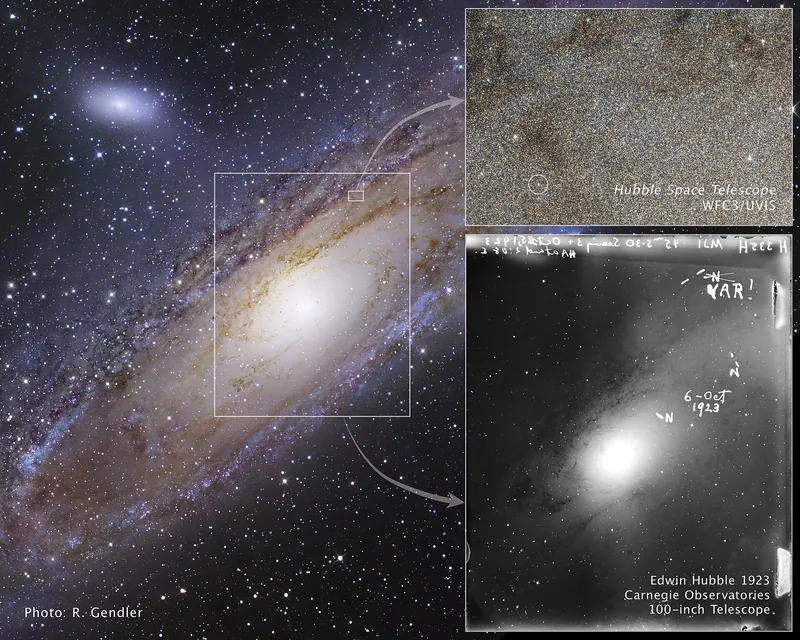
On the night of 5 October 1923 Edwin Hubble began an observing run that lasted into the early hours of 6 October. NASA, V1
In poor conditions he made a 45-minute exposure and marked three suspected novae, exploding stars, with an ‘N’. NASA, V1
Step 3: One “nova” misbehaves
Comparing that plate with older ones, he found one ‘nova’ dimmed and brightened far faster than a nova should. NASA, V1
Why one star was enough
A Cepheid brightens and fades in a regular pattern, like a lighthouse, and was already known to be a reliable distance marker. NASA, V1
V1 takes a little over 31 days to brighten and fade once. NASA, V1
NASA says Edwin Hubble measured Andromeda’s vast distance by finding a variable star that served as a ‘milepost marker’. NASA, 2012
What happened next
Harlow Shapley, who believed the nebulae were part of the Milky Way, reportedly said of Hubble’s letter: “Here is the letter that destroyed my universe.” NASA, V1
From them he worked out a distance of 900,000 light-years; better measurements later moved it to about 2 million. NASA, V1
Britannica: only in the 1920s did Hubble show conclusively that Andromeda is a separate galaxy. Britannica
A tribute, 88 years on
An astronomer at the Space Telescope Science Institute called V1 “the most important star in the history of cosmology”. NASA, V1
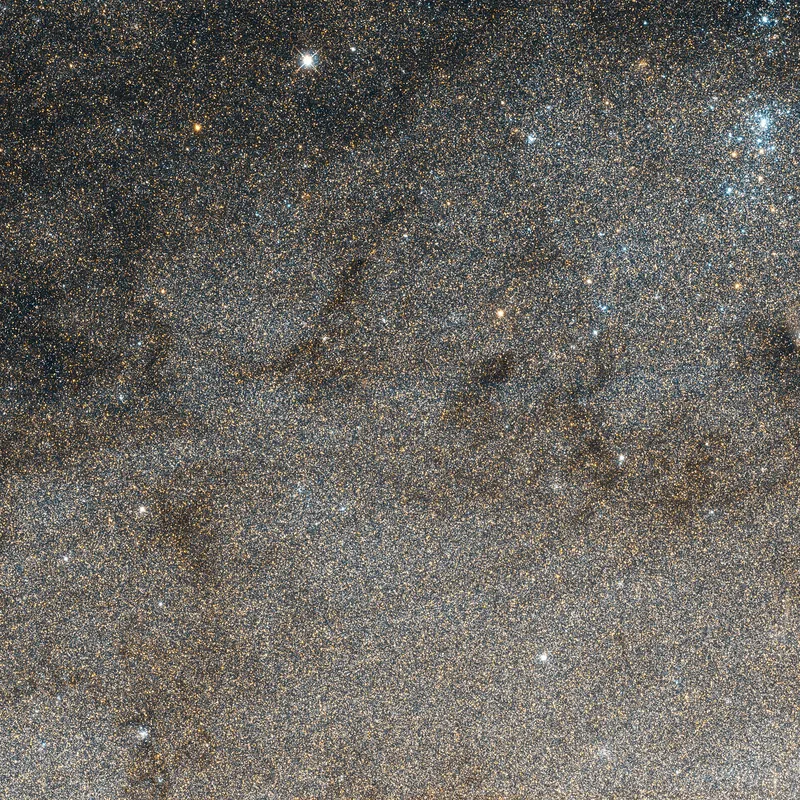
In 2010 and 2011 amateur astronomers tracked V1 and the Hubble Space Telescope photographed it again, as a tribute. NASA, V1
Cepheids are still the first rung on the ‘cosmic distance ladder’ astronomers use for far more distant galaxies. NASA, V1
Our view: the most important exclamation mark in science was written on a photographic plate after a night at the telescope, by someone who could have just gone to bed.
Next: inside Andromeda →