What Hubble sees inside
Hundreds of millions of single stars, dust lanes, a black hole and the remains of eaten galaxies.
How this site works. Every fact is in our own words and linked to its source, beside it. Where good sources disagree, we show each version in a “Sources differ” box.
The giant pictures
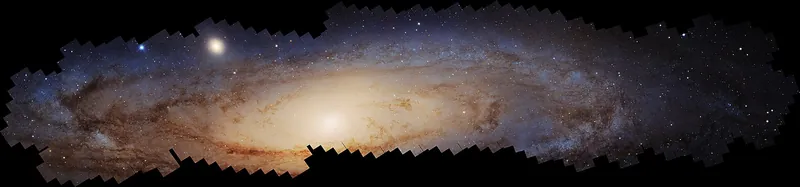
In January 2025 Hubble released an even bigger panorama: about 2.5 billion pixels and 200 million stars. NASA, M31
It took over 10 years and more than 600 overlapping Hubble snapshots. NASA, M31 It needed over 1,000 Hubble orbits. NASA, M31
In January 2015 Hubble released a 1.5-billion-pixel mosaic of part of Andromeda, showing over 100 million stars. ESA/Hubble, 2015 Showing that 2015 image at full size would take more than 600 HD television screens. ESA/Hubble, 2015
NASA likened resolving single stars at that distance to photographing a beach and seeing individual grains of sand. NASA, M31
Even 200 million stars is only a fraction of Andromeda’s population. NASA, M31
What you are looking at
Cooler, yellowish stars crowd the centre; a blue ring of young stars and star-forming regions marks a spiral arm. NASA, M31
The dark silhouettes in the pictures are complex lanes of dust. NASA, M31
NGC 206 is the most conspicuous star cloud in Andromeda. NASA, M31
Some bright ‘stars’ in Hubble’s picture are photo-bombers in our own Milky Way, much closer to us. NASA, M31
The black hole at the heart
There is a supermassive black hole at Andromeda’s heart. NASA, black hole In 2005 Hubble measurements put its mass at 140 million Suns, three times more than once thought. NASA, black hole
A disc of hot, young blue stars whips round the black hole, rather like planets round the Sun. NASA, black hole
What looked like a double centre is a ring of old red stars about five light-years from the black hole. NASA, black hole
More about supermassive black holes is on our sister site, black-holes.galaxies.im.
A galaxy with a big appetite
Andromeda has a past of collisions, swallowing smaller galaxies. Britannica
Deep surveys of its outskirts show huge streams and clouds of stars, the remains of smaller galaxies it has ‘eaten’. Britannica
NASA says the Milky Way has been relatively placid, but Andromeda has had a more dynamic history, probably including a major merger a few billion years ago. NASA, 2025
In 2018 University of Michigan scientists concluded that Andromeda shredded a massive galaxy, now called M32p, about two billion years ago. U. Michigan, 2018
M32p would have been the third-largest galaxy in the Local Group, after the Milky Way and Andromeda. U. Michigan, 2018 It was at least 20 times larger than any galaxy that ever merged with the Milky Way. U. Michigan, 2018
They suggest the dense little galaxy M32 is its surviving centre, like the pit of a plum. U. Michigan, 2018
One of the scientists, Eric Bell, said: “M32 is a weirdo.” U. Michigan, 2018
Our view: every one of those 200 million stars is a sun, and many probably have planets. It is a picture of a lot of other people’s skies.
Next: the satellites →