Andromeda’s strange family
Three dozen small galaxies, most of them on the wrong side.
How this site works. Every fact is in our own words and linked to its source, beside it. Where good sources disagree, we show each version in a “Sources differ” box.
The census
Hubble has studied the whole known population of 36 small satellite galaxies orbiting Andromeda. NASA, 2025
The survey built a 3D map of the dwarfs and worked out how they formed stars over nearly 14 billion years. NASA, 2025
Many of Andromeda’s dwarfs kept forming stars slowly for far longer than expected, something computer simulations don’t show. NASA, 2025
The bright companions
The brightest companion is M32, a compact galaxy that may be the leftover core of a larger galaxy that hit Andromeda a few billion years ago. NASA, 2025
Britannica’s pictures show M110, an elliptical galaxy that is another satellite of Andromeda. Britannica
The Royal Observatory says its two dwarf elliptical satellites can be seen with a small telescope. Royal Observatory, closest
All in a line
Half of them seem confined to one plane, all orbiting in the same direction. NASA, 2025
One researcher, Daniel Weisz, called that “weird”: a total surprise nobody fully understands yet. NASA, 2025
Lopsided
Most of Andromeda’s dwarf galaxies lie on our side, between Andromeda and the Milky Way, and better distances show that lopsidedness is real. Sky & Telescope
How unusual is it? Sources differ
- A 2025 Nature Astronomy summary says that degree of lopsidedness turns up in only 0.3% of similar simulated systems. Nature Astronomy
- Sky & Telescope reports that, after removing look-alike cases, only 0.1% of simulated galaxies were as lopsided as Andromeda. Sky & Telescope
Both come from the same 2025 study. The smaller figure is what was left after look-alike cases were removed.
The researchers say this needs either a very unusual history, or may hint that our standard picture of the cosmos is missing something. Sky & Telescope
Triangulum
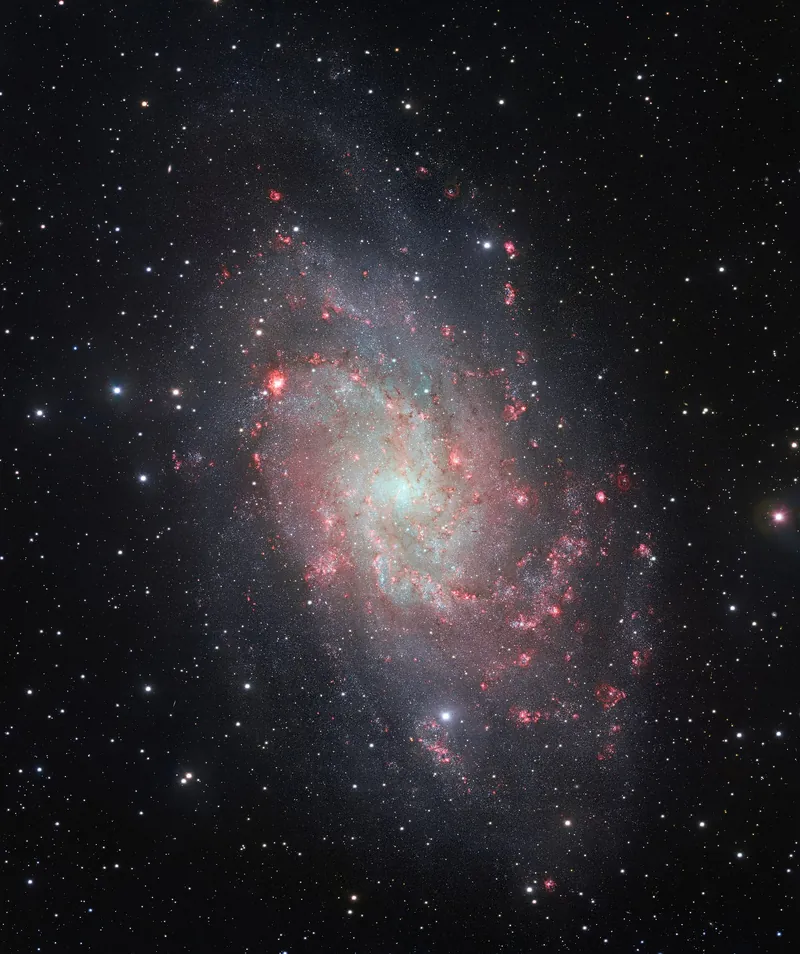
The Triangulum galaxy, M33, is a smaller companion at a similar distance, and much harder to see. Royal Observatory, closest
Our view: a galaxy whose family all sit on one side, facing us, is either a cosmic coincidence or a clue. We like clues.
Next: the coming meeting →